Hey there, everybody 🙂
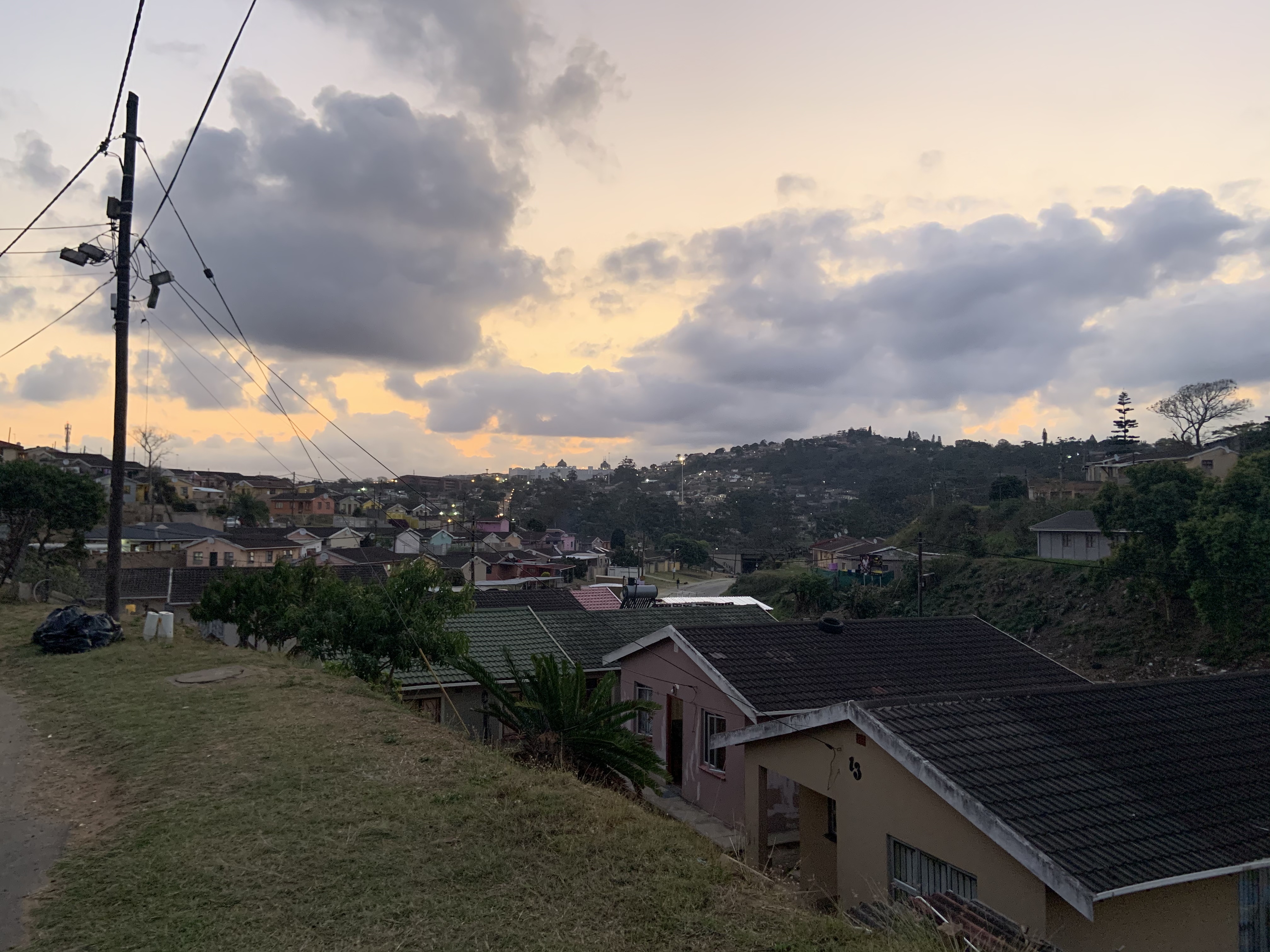
This past week has been full of “real deal” kinds of shifts in my program. I moved in with my first host family in Cato Manor, Durban, I started taking my actual courses from around 8:30 am-5:00 pm each day, and began the (deep) dive into learning the Zulu language.
My host family is wonderful. I live with my Mama, one of her daughters, two of her grandchildren, and one of Mama’s cousins, who I call my Gogo. “Gogo” is the Zulu name for Grandmother, and it is used to refer to all older women in the family/community regardless of their relation to you. (Just a heads up: I could write a lot more about my family than I’m going to write on this blog. I’m not going to disclose too much because I want to be very careful about using their names, personal stories, etc. Sometimes, travel blogs about experiences like mine can develop an air of voyeurism or elitism, like the writer is on some level above their hosts, observing for the sake of a story. That’s not what this is about.) The grandkids are at the adorable ages of 2 & 4, and constantly want to play and be held. My Mama is incredibly strong—she works full time and rents rooms in a second building next to her house, and she spends all the rest of her time taking care of other people, including me. There’s a popular quote that stems from women’s mobilization in the liberation movement: “When you strike a woman, you strike a rock. You have dislodged a boulder. You will be crushed.” That’s Mama. She’s a rock.
Learning Zulu is going to be an adventure in and of itself. Basic sentences like “Igama lami nguIsabel,” or “My name is Isabel,” are fairly easy to understand. Igama=name, lami=my, and the “ngu-” prefix=is. The “I-“ prefix denotes that I’m talking about myself, and there are different prefixes to nouns that you use depending on the subject/number of people you are talking about. There are a ton of exceptions in the Zulu language—especially when you are writing—since it has historically only been an oral language. Here are a couple of the more tricky sentences we’ve been using in class:
Ubaba nomama basaphila futhi ngiyabathanda.
->English: My dad /and mom are doing well and I love them.
Ngiyawuthanda umdeni wami ngoba uyangithokosiza.
-> English: I like my family because they make me happy.
*This literal translation is a bit different: I like family my because they make me happy. Notice how “they make me happy” is all one word!
Last week during orientation our program discussed the concept of a social/cultural adjustment curve. Basically, I’m going to feel really great and comfortable for periods of time when I’m abroad, and I’m also going to go through stretches that feel crappy and uncomfortable. Those things will come in waves, with varying intensity. It’s a helpful tool because it is unrealistic to think of “culture shock” as something that you experience and then get over. Instead, adjusting is a process! And I’m in the midst of it now.
Last week was the honeymoon phase. I was in a new country with new friends! Everything was new and exciting! I wasn’t on planes anymore! I could see the beach! I was at the top of the curve. Now, I’m on my way down. Everything is still new and exciting, but now I’m using less exclamation points, literally and figuratively. I think the best way I can describe why this happens (at least right now) is this: at a certain point, you start focusing not just on the newness around you, but your place within it. You realize you’re going to be in this place for a while. That’s awesome. It’s also intense.
I’m noticing so many things about myself and about other people, and doing a lot of the processing I wanted to come here and do. Some of it is long, much of it is tough, and all of it needs more thought before it turns into a blog post. However, there are many humorous and joyful experiences that are just simply silly or happy. A ton, actually. That’s what I want to focus on for the rest of this post. (Regularly scheduled socio-political content will resume, don’t worry.)
Number One: Bubbles
One of the little grandkids ran out to the street meet me when I first arrived in Cato, dragged me into the house, and jumped right into my lap to play. It was SO cute. After a short while, she looked up at me, suddenly very serious, and said: “Where are my bubbles!?” I hadn’t said anything about bubbles, but she meant business. It was a good thing that I’d brought some as a gift for the kids! Otherwise I would’ve been in trouble.
Number Two: Jazz
Wednesdays at the local university are free jazz concert nights featuring students in their jazz program, which is really renowned in the country. The music is fantastic. Last week, a female student played a full hour and a half of her own music with a band of other students. Her songs were very soulful, often Zulu-infused jazz that worked in a lot of audience participation. I didn’t realize how much I’d missed singing. It really reminded me how powerful music is, and how it can make you feel at home in places you’ve never been before.
Number Three: Squash Shade
My host mom is very traditional. Her version of loving hospitality is to do practically everything for me around the house and treat me like a guest. I really really appreciate this, but I don’t want to be seen as entitled or as a burden. On the first night, she was cooking dinner and I asked her if I could help. She only allowed me to dry a couple dishes and then told me to sit down at the table and get off my feet. The second night went basically the same way. And the third night, I asked again and she told me that I could help her chops and vegetables, which I was really excited about. If you know me, you know I love to cook. Then she handed me a large squash, told me to cut it into cross sections, and to peel the skin off. I’d cut squash before, she’d given me a task, and I was feeling good. Things went downhill from there. The squash, which was very curvy And different from any squash I had ever battled before, was literally as hard as a rock. I say “battle” because that is what it was. I consider myself to be fairly strong, and I was putting my full strength and weight of my upper body into cutting this squash into circles. It was rolling around and slipping out of my grip as I tried to figure out the best way to hold it and cut it. I started to get a little flustered because this was my chance to prove myself to Mama and I did NOT want to seem like I did not know my way around a knife. Then I had to figure out how to peel the skin off the damn thing. To make things even more embarrassing, at one point I asked Mama to come over and check to see if the slices were thin enough. She picked up the knife, slammed the squash onto the cutting board, and cut three perfect, super-speed slices before handing the knife back to me with an encouraging smile. (That quote isn’t messing around when it says “You will be crushed.” Just saying.) By the time I finished removing the seeds, peeling the skin, and cutting the slices I’d literally spent about thirty minutes on this squash. She doesn’t say anything to me as she put the squash chunks into a pot on the stove. I also had to cut an onion, so I start doing that. (Hello, comfort zone.) I race through this onion by comparison, and I breathe a sigh of relief. I turn around with my onion, feeling like I’ve already salvaged some pride. Mama looks at me, looks at the onion, looks back at the squash, and says with wide, amused eyes, “Wooow!!! So fast with that one!!” Squash: 1, Isabel: 0.
Number Four: A Pretty Darn Cute Language Barrier
The youngest grandkid in my homestay house is two years old, and I’ve come to the conclusion that this very small, very chatty child has no. idea. that I don’t speak Zulu. He’ll babble on and on and then expectantly squeal at me, looking very cute, and I have zero clue what he’s telling me. It’s very funny. I did, however, figure out that “Asa!” (something he yells to me a LOT) is his version of my name, which was so exciting!!! He hasn’t quite gotten “Isa” figured out yet, and that’s just fine with me.
Number Five: Keep Left
I’ve ran into a lot of people since I’ve arrived in South Africa. Physically. Not like: “Oh hey, I didn’t expect to see you in this public place halfway around the world!” but like: “Oh shit, I just rounded a corner and accidentally walked straight into this stranger, or I tried to dodge at the last second and almost fell over. In public.” A bit of advice: if you’re in a different country and are trying to make it obvious you aren’t from there, this is a great strategy. People are generally very confused and/or irritated and will probably pay a lot more attention to you than they previously may have been inclined to. If you’d like to give this a try, all you need to do is go to a country where people drive on the left side of the road, not the right, since people also walk and pass each other on the same side they drive on. Then, simply walk on the right side (the wrong side). Lucky for me, South Africans drive and walk on the left, which is very hard to remember, so it’s been easy to consistently make a fool of myself this past week.
The type of travel I’m doing can be tough, but it is also wonderful and very funny. One of my big takeaways from this week is that sometimes, if I take myself too seriously I am my own worst enemy. I’m reminded that laughing at myself is good, learning is good. Squash might try to squash you, but you’ll get through it. Find ways to sing. Carry bubbles. And, for god’s sake, keep left.
-Isa
ps- There were some really terrible xenophobic attacks in South African over the past couple days, causing a lot of violence and looting. They’re the worst attacks of this kind since apartheid ended, and target foreign nationals in a way that is really heartbreaking for the government, its people, and African immigrants in particular. If you’ve seen things on the news, please know that the chaos of these events is mainly in Joburg, and I’m safe. We’re being extra careful just as a precaution.
 Isabel's Semester in South Africa Fall '19
Hello Isabel, I am enjoying your blog. So glad things are going well. Thanks for taking us on this journey. Sending you big hugs! Love ya! Roo😀
LikeLiked by 1 person
Thanks, Uncle Roo!!
LikeLike
Thanks for addressing that last thing, Bel. Glad you are safe and well cared for. I love the story telling and can picture it all. Very fun! Love you. Dad
LikeLiked by 1 person
Love you!
LikeLike
ISABEL: 1000000 meanie squash: -5
LikeLiked by 1 person
Hahahahha I WISH. Love you
LikeLike
ASA! I love that. I’m happy tearing up right now after reading that post, and also maybe a little bit sad at the thought of you so far away in this big ole world. The bubbles story reminded me of Jemma. 🙂 Makes me happy to think about how much we have in common with other cultures. We miss you and love you very much!
LikeLiked by 1 person
I love it, too. 🙂 miss you, big brother. I’m so grateful to have a house with little kids because I don’t feel as far away from you guys! Jemma would love playing with these guys, I know it. Love you!
LikeLike