Oppression can exist anywhere, under any government, with any freedom, and after revolution. (Paraphrased quote from Albie Sachs’ most recent book I’ve been thinking about this week.)
This week we met Gandhi’s granddaughter, who has been a long-time representative in SA’s parliament and member of the ANC. We also visited Gandhi’s settlement not too far from the city of Durban. We’re told about Gandhi’s legacy in the US, but not anything too in-depth about his past. (Actually, I think most of what I know about him comes from a 5th grade research project I did on him. We had to dress up— I wore a bald cap. It was a lot.) South Africa is where Gandhi was transformed into an activist. He came here, an aristocrat on business, and experienced the oppressiveness of apartheid because he wasn’t white. It was at the Durban settlement where he lived and tested a lot of his ideas about conservation and peaceful resistance, commune-style with followers who moved to settle there with him. Gandhi was also problematic and deeply classist and racist for much of his life as an activist, and his time in South Africa highlighted this. Indians in South Africa came to South Africa in two groups: well-to-do merchants and indentured servants. Gandhi excluded the latter group from his struggle, and it took a long time for him to recognize how further disenfranchising the disenfranchised was wrong! Gandhi used racist rhetoric against black South African natives to degrade them in an attempt to advance the social standing of the Indian trading class. It was blatant and disgraceful. So, Gandhi isn’t revered here like he is around the world, he’s seen as quite problematic.
I appreciated the honesty about this at the settlement— they weren’t trying to cover it up, but focused on what’s to be learned from all parts of his legacy. This openness about the shortcomings of one of the world’s most influential revolutionaries renewed my motivation to reflect about my own. If even Gandhi made mistakes and held deep implicit biases, there’s no way any of us are exempt from doing real work to uncover the ones we each have inside of us.
I’ve been thinking about race a lot, definitely more than I’ve written about it so far. Every day, I’m in new situations to reflect about my whiteness. I’ve often been the only white person in public spaces (and private ones), and I think it’s really important for all white people to experience being a minority in that way. We aren’t used to it, and so we don’t think about how our norms dominate spaces or how we could be more mindful of that reality. Every day, I’m a guest in a space that’s not mine. That takes practice, a lot of thought, and a lot of energy if you’re going to do it well. (I mean specifically for white people; I know that people of color navigate white spaces often and I’m not the person to comment on that.) I’m not doing it well all the time, but I’m trying. Sometimes I feel really out of place and uncomfortable, and I think a lot of that discomfort comes from the fact that I’ve never spent so much time in a place where white isn’t the majority. I try to notice those emotions, think about why I’m feeling them, and dive back in. Diving back in seems like the most important part, the part where you recommit to being vulnerable and doing the work. Also, I’m not talking about this to get praise or anything for doing the work. The work isn’t anything special. It’s simply decent. It’s just about paying attention to the humanity of other people when society has taught a part of your core not to. It’s like the Zulu word “Ubuntu,” which is written into South Africa’s Constitution. It means: “I am because you are.”
Non-white South Africans have a spirit of forgiveness I don’t quite understand yet, and I’m not sure I will by the time I leave. People have explained it to me as a sort of desperation for unity, a manifestation of the importance of ubuntu in SA’s culture, an exhaustion with conflict, and/or a commitment to building a better society. All this is difficult for me to reckon with because I view inequality here through a lens of institutional racism, that injustices perpetuated by white people are responsible for disparities in wealth, health, etc. Notably, people of color are a majority here in a way they aren’t in the US. Maybe they have the political power, so why not show mercy? Mercy seems like what it would take to forgive a group of people who brutally and systematically suppressed, manipulated, and murdered you for decades and still owns 70-80% of the land. The narrative of strength and victory for POC that I’ve been presented with here seems to be rooted in the ability to reconcile and build the “rainbow nation,” while the equivalent of that narrative in the US seems generally more tied to resistance.
Resistance makes sense to me as an American. So much shame should be a part of a white person’s daily experience here, it seems. When making friends with black South Africans here and telling them about my interests in politics, race, and inequality, several have been shocked I knew what white privilege and institutionalized racism were. One guy had to sit down. “White people here just don’t get it,” he said. “They think that because apartheid ended, racism isn’t an issue. Like it isn’t possible.” Then he apologized if he was being racist (!!?). I told him to keep going. So, I’m both curious and irked when I see white people in public. “You benefitted from the most perfected racist system in the history of the world— and still do— and you’re showing your face right now? Really?” That’s maybe dramatic, but that’s basically what goes through my head. I thought I’d be more focused on making myself seem un-American when I came here because I was nervous about how African people would perceive that privilege. But that’s actually the opposite of what’s going on. I find myself trying to seem obviously American so I’m not confused with an Afrikaans person! I don’t want to be associated with the people who orchestrated apartheid, nor the people who think the struggle against it is over.
(Important note- Obviously, I’m making generalizations. If you’re white and those bother you, know this: I know there are decent white people in this country. I’ve met them. However, I’m not pulling any punches. Addressing inequality and racism— the true “healing” South Africa wants— takes more scrutiny, not less. And even decent, conscientious white people need to learn to live with the understanding that they benefit from a racist society and what that means.)
Those reflections were about seven weeks in the making, so thanks for reading through all that. In others news, I’m healthy, I’m happy, and my new host family in the suburb of Newlands has been great. I’m definitely aware that I’m more comfortable there because there is less of a language barrier and because the quality of life is more similar to what I’m used to back home. There’s running hot water, I don’t have to take baths using a plastic bucket, and my siblings have a PlayStation. Newlands is also a colored neighborhood. *Important tidbit: “mixed” is a derogatory term in SA, like “colored” is in the US. The accepted term for mixed race is “colored”—this has been a strange adjustment for sure!* Apartheid designated Newlands as a colored township, and as with almost all Durban neighborhoods, its demographics haven’t changed. Oppression’s impact persists.
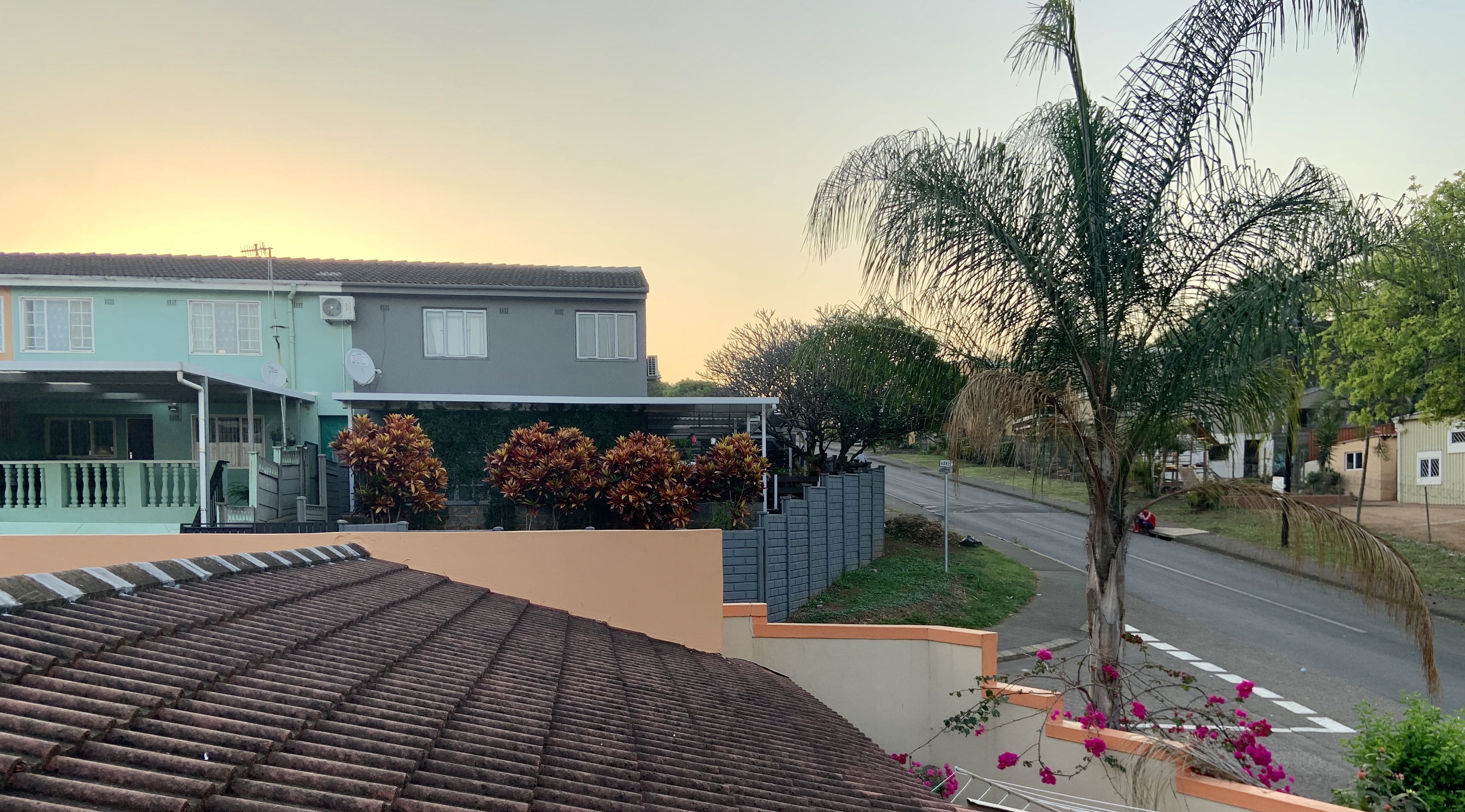
Homes in the neighborhoods around Durban are embedded into the landscape unlike any place I’ve ever been to. Durban’s hills roll. Both in the informal settlements and in formal communities, all the colorful houses make the hills look like a flowing patchwork quilt. And at night, there are lights everywhere. If you forget about the light pollution for a second when you’re driving down the highway, it’s pretty astonishing to see all the lights shimmering as you whiz past. I’m leaving Newlands and the lights of the city for a week— we’re always on the move— to go to the rural area of Amatikulu for my rural homestay. My host family refers to it as my time “on the farm.” No running water, no indoor plumbing, tin roof, etc. The point is to be challenged, and I’m excited to soak it up and write about it soon.
-Isa
 Isabel's Semester in South Africa Fall '19
Just reading this now as my first birthday treat! Really interesting encounter with the guy who had to sit down… so different than Kenya. Many fewer whites there. Blacks have most of the power and the land. My sense was that whites largely were respectful by necessity, but not in a begrudging way. There certainly was not a white party. It would be interesting to know if there is one party the whites tend to join. In the city I was seen as a tourist. It wasn’t a bad thing to be American. I think they actually loved that I was American because they liked our culture (Michael Jordan was big then). And we clearly stood for freedom and dignity back then. That that is harder to say now is a great sadness for us and the rest of the world. Anyway, great post. Love you,
Dad
LikeLiked by 1 person
Love you too!!! Happy birthday again ❤️❤️
LikeLike